Wesley Place
Wesley Place is gathered around the earliest intact church complex in Victoria. Joseph Reed’s Wesley Church, its school house and manse were built in 1858–59, and the site has been a centre of Methodist welfare work since the 1850s. Charter Hall restored five heritage buildings and added a new tower at 130 Lonsdale Street, creating workplaces for 5,500 people around a public realm that covers almost half the site.
Broached analysed the historical use of the site and Methodism’s role in Melbourne’s early urban development. Two themes set the direction: the meeting of Protestantism and modernism, through the Protestant belief in freedom of inquiry that shaped liberal democratic institutions; and reconciliation. The Uniting Church asked that the forecourt’s main work acknowledge the strength of living Kulin cultures.
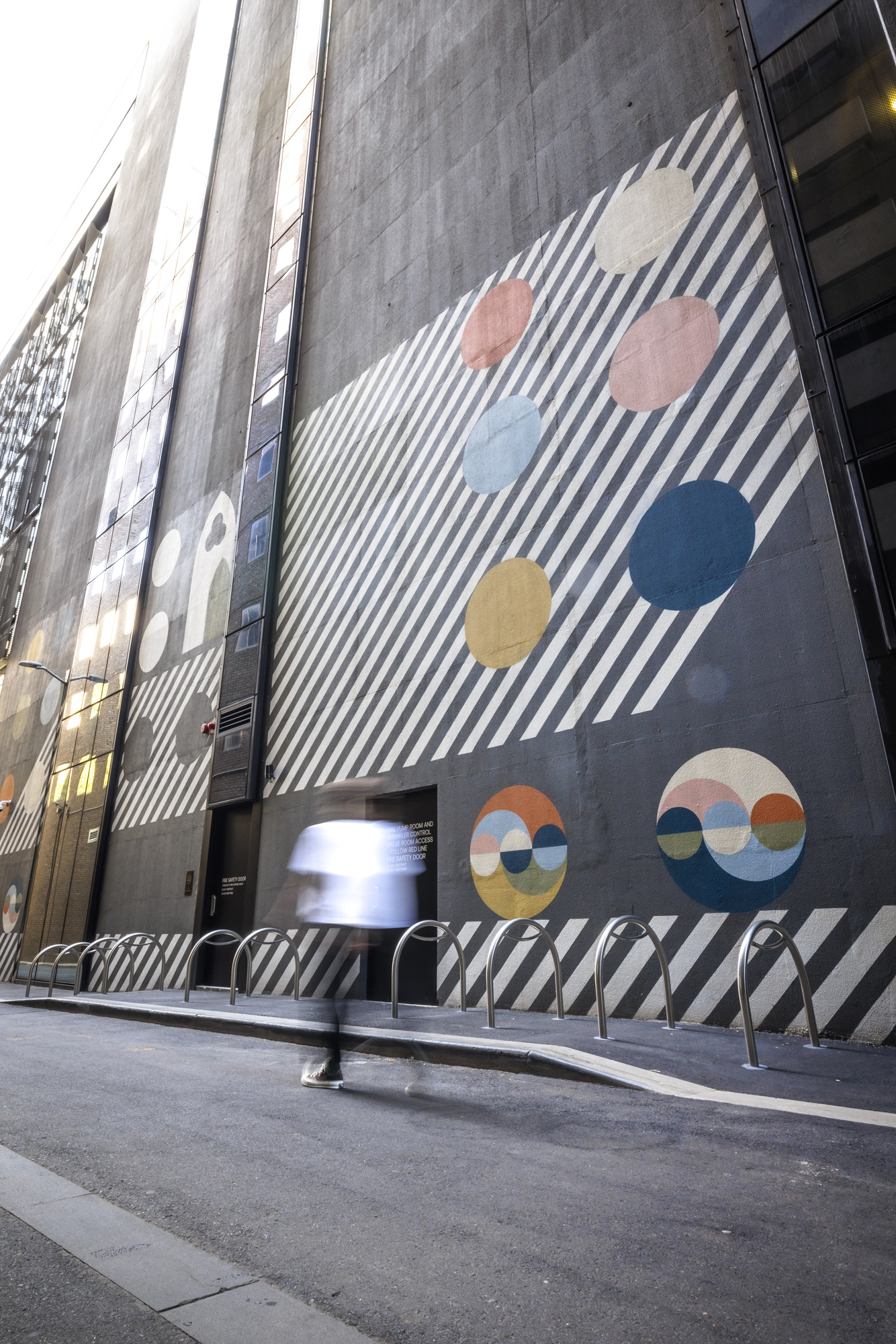
There, Maree Clarke and Trent Jansen’s bronze benches, Balit-dhan Balit nganjin (Their Strength Our Strength), stand as a counterpart to the statue of John Wesley. They honour Louisa Briggs, William Barak and Coranderrk, their cast branches recalling the station’s hop poles; N’arweet Carolyn Briggs and Aunty Joy Wandin Murphy were consulted. In the colonnade, Clarke’s film Gulinj-al Ngulu Kerr-up-non biik-u (The Voice of Kulin Kin Country) animates 3D scans of the objects that carry her experience of Country. On the east façade of 150 Lonsdale Street, once home to the Bureau of Meteorology, Stanislava Pinchuk and Broached created Axionome, one of the largest artworks in the state. Each night it compares the day’s temperature with Melbourne’s climate normal.
Axionome
Axionome is an interactive mural at skyscraper scale. This artwork is a static mural by day, and a data driven gauge for Melbourne’s temperature deviation by night. It is the largest permanent artwork by the artist, who began her career as a street artist in Melbourne before achieving international recognition for her works on paper and minimalist sculptures, which incorporate geopolitical data from migration, wars, and climate catastrophes.
Located on the facade of 150 Lonsdale Street, formerly home to the Bureau of Meteorology, the mural responds to daily recorded temperatures. Utilising data measured nearby in Melbourne’s CBD, the artwork reveals temperature deviation by comparing the current day’s temperate to the same day’s historical average over the past century.
The artwork takes its inspiration from the movement of the sun and the moon, the most enduring systems of human timekeeping. Two lights traverse the façade, gently animating the painted design in order to convey how each day’s temperature compares to historic climate data, which is shown on a scale from -1 to +3 degrees. The light show ends at midnight, resetting in anticipation of reflecting new climate data for the following day.
Gulinj-al Ngulu Kerr-up-non biik-u (The Voice of Kulin Kin Country)
Gulinj-al Ngulu Kerr-up-non Biik-u (The Voice of Kulin Country) is the first video artwork by the artist, and features objects from her personal collection which have been 3D scanned and animated. Here, natural materials appear as constellations in a landscape of branches, like moons orbiting a planet. For the artist this symbolises equilibrium with the environment being a central principle of land use, practiced by communities of the Kulin Nations for thousands of years. This new landscape – both hyper-realistic in its detail, and fictional in the way objects are digitally composed and animated – is a tribute to the clans and languages that have been lost across the Kulin Nations since colonisation, and which exist in the realm of memory.
Balit-dhan Balit-nganjin (Their Strength, Our Strength)
Balit-dhan Balit-nganjin (Their Strength, Our Strength), comprises two sculptural benches, designed by artist Maree Clarke with furniture designer Trent Jansen, as a tribute to the history of Coranderrk Aboriginal Reserve of the late 19th and early 20th centuries. The forms and materiality of the benches embody ancient Kulin Nations cultural practices, and the ingenuity and strength shown by Wurundjeri Elders instrumental in the establishment of Coranderrk, including Simon Wonga, William Barak and Louisa Briggs.
Coranderrk Station was situated in the Yarra Valley, around 60km from here. It was established as an Aboriginal Reserve by the Victorian Government in 1863, as a haven for Kulin Nations peoples to live and work, during an era in which Indigenous peoples were dying in huge numbers across Victoria as a result of frontier violence and exposure to foreign diseases. This was precipitated by a group of 15 Wurundjeri, Taungurung and Boonwurrung men, led by Uncle Simon Wonga, walking from the site to Melbourne with gifts for the Crown and a request for ownership of the land. Two further walks from Coranderrk to Melbourne were undertaken to make petitions to the Government about its management and conditions; the community’s political engagement in their struggles for autonomy becoming a precursor to the Land Rights movement.
Initially established as a hops farm, the Coranderrk harvests achieved commercial success rivalling that of surrounding settler farms. The benches capture the strength and perseverance shown by the community in their form; the long branches represent the process of preparing hops, and the sharing of Kulin Nation knowledge, despite attempts to outlaw their cultural practices. The river reed seat renders in bronze materials used by Boonwurrung women like Louisa Briggs to create welcome to country necklaces, a tradition which Maree Clarke continues with her community today. The charcoal seat represents fire, associated with men’s business, which was conducted by Kulin Nations men like William Barak.
Balit-dhan Balit-nganjin is also imagined as a place of refuge for those following in the steps of the Indigenous Elders who walked with great symbolism in demand of human rights and self-determination.
A Million Times 61c (Tidal)
A Million Times 61c (Tidal) is crafted and milled from one block of aluminium, coated in dark blue with metal-finish clock hands. The piece belongs to the Tidal series of works, which were inspired by the vision of sunlight reflecting on the surface of water, while the cyclical and cumulative patterns shown by the clock hands are themselves wave-like, a constant ebb and flow between reporting the time each minute. The placement of the work here is intended to reflect the lived experience of locals and visitors. The choreography of the clock hands is mimicked in the fluid movement of people to, from and within the city as they go about their daily lives, and evokes the way in which refracted sunlight is experienced within the modern city, as it catches the façades of office and apartment towers.
Humans since 1982 is a contemporary art and design studio creating exclusive objects based on accessible concepts, with the aim of enabling people to reflect on everyday life.