The Continental
The Continental opened in 1876, built from local limestone by George Coppin’s Sorrento Hotel Company on Boonwurrung Country. Coppin made Sorrento a resort for Melbourne, with steamers from the city and a tram to the hotel’s door. From the 1980s it ran as a nightclub.
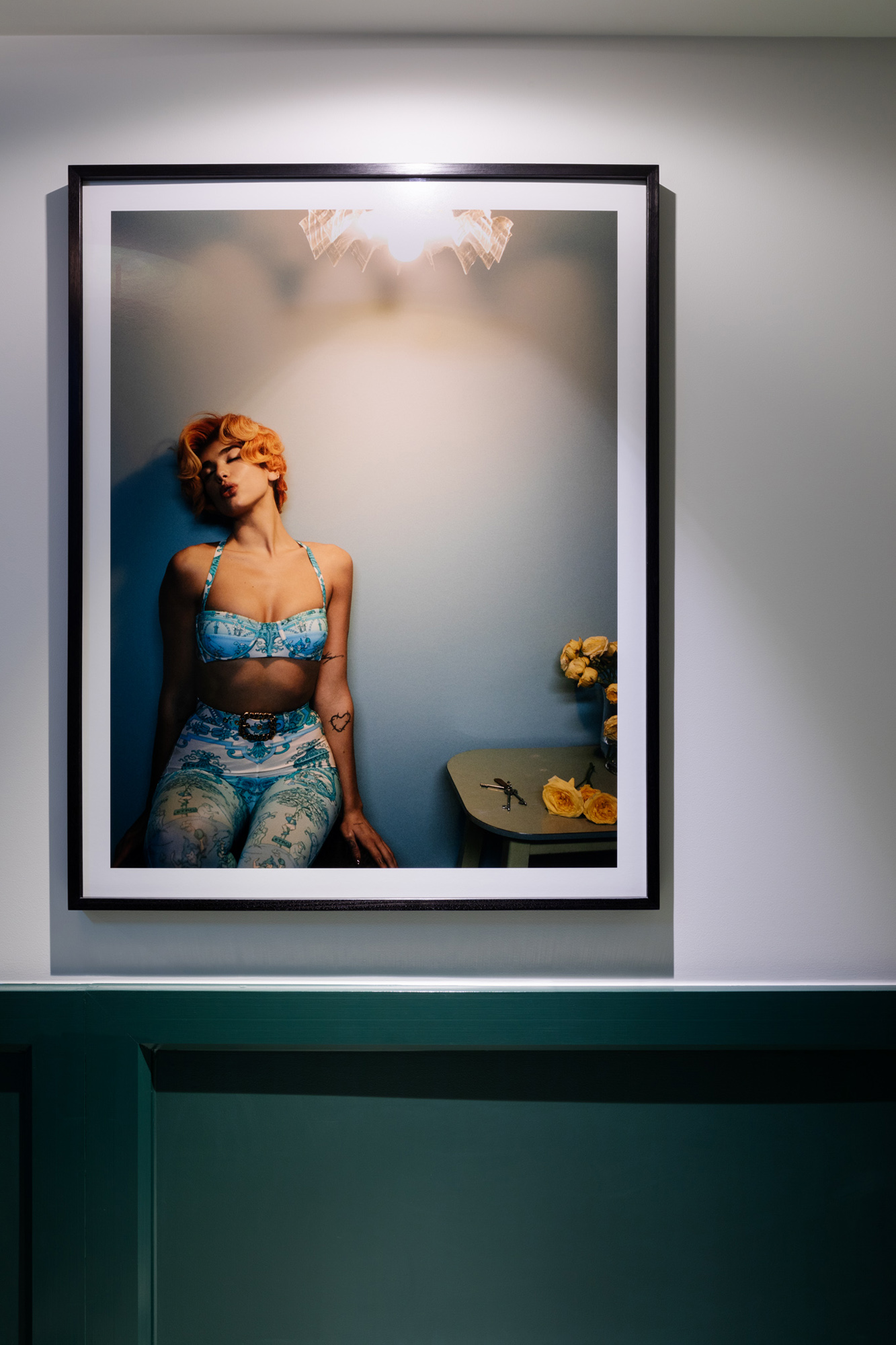
Victor Smorgon Group, the Kanat Group and Trenerry Property reimagined it as a place of revelry and rejuvenation, with Woods Bagot’s design built on rebirth and nostalgia. Broached curated and commissioned the art as a second layer to that direction. The research found its central motif in Edith Coleman, the Sorrento naturalist who discovered how orchids are pollinated. It also widened the nostalgia. Coppin’s resort excluded Indigenous Australians, Melbourne’s LGBTQ community and women travelling freely on their own, so the collection includes photography by Christian Thompson, Emma Summerton, Paul Knight and Fergus Greer.
Behind reception, Adam Goodrum and Arthur Seigneur’s straw marquetry Orchid Opus follows the life cycle of the endangered Frankston spider-orchid, beside a first edition of R.D. Fitzgerald’s folio of Australian orchids; Goodrum carries the motif into brick reliefs at the entrance. John Warwicker’s typographic works draw on Coppin’s own notices from the State Library archives, and his coloured heritage photographs of the Peninsula hang in the guestrooms with Rosslynd Piggott’s floral photographs. Azuma Makoto’s still lifes grace Audrey’s in honour of chef Scott Pickett’s grandmother. In the heritage wing, a salon hang pairs Rennie Ellis’s photographs of the Peninsula with images from the late nineteenth century.
Audrey’s Garden Series
Commissioned for Audrey’s at The Continental in honour of Scott Pickett’s grandmother, after whom the restaurant is named, these still life photos feature flowers and ingredients that Audrey grew in her garden, now incorporated into Scott Pickett’s cooking.
Orchid Opus
In celebration of the endangered Frankston Spider-orchid endemic to the region, the six panels positioned behind the hotel reception desk present the orchid’s life cycle: germination, growth, maturity, decay, and rebirth, through a palindromic, linear design. Taking inspiration from the geometry of the anatomy of the orchid, this homage to the fragile orchid represents hope for its conservation through a vibrant, pulsating, riot of colour that evokes the life force needed for it to propagate and bloom.
A&A is the collaboration between Australian industrial designer Adam Goodrum and French marquetry artisan Arthur Seigneur. They are represented by Tolarno Galleries, Melbourne.
Botanical Bitmap
Adam Goodrum has played a central role in the decorative arts language of The Atrium, hotel reception and arrival concourse from the porte cochere. His works are all inspired by the orchid flower, which is a homage to the famous Australian naturalist Edith Coleman who discovered how orchids are pollinated. Adam has created beautiful abstractions of the orchid that work with the material language of the space in which they are placed.
In this work, Adam used digital design software to program the angle of bricks so that they would abstractly represent the petals of an orchid. An algorithm was purpose built to generate tonal maps that determined the tilt of each brick and translated a 2D flat tonality to a plan for 3D brick laying. The art of this work is translating binary data to pixel units, in upscaling pixels to the scale of bricks.
Australian Orchids 1875–1882
Art collection curators Broached Commissions set out to curate a lineage of works between Edith Coleman (the world-famous naturalist from Sorrento who discovered how orchids pollinate) and the history of the colonial study of Australian orchids. There was huge speculation in Europe around the flora and fauna that might be discovered in Australia, the last great land mass to be colonised. Folios of botanical drawings by naturalists such as R.D. Fitzgerald were hugely important to tracking and understanding the world’s biodiversity.
The exquisite lithograph plates, which included enlargements of Fitzgerald’s painstaking dissections, were hand-coloured by various artists from instructions and sample sheets coloured by FitzGerald. This work brought him fame. J. D. Hooker considered it ‘a work which would be an honour to any country and to any Botanist’, while George Bentham wrote, ‘Thanks to you the Australian Orchideae are now better known than those of any other country out of Europe’.
– from the Australian Dictionary of Biography website
Figures such as Robert D. Fitzgerald were usually amateur naturalists who had day jobs, such as being surveyors. They gridded and carved up the land – ultimately causing massive environmental degradation – while at the same time hunting around for ‘undiscovered’ flora as naturalists. The irony was completely lost on them.
Rennie Ellis Archive
Portrait photographs 37.5 x 25 cm
Welcoming patrons through The Conti Bar are works by the prolific social documentary photographer Rennie Ellis, who more than almost any other photographer of his generation captured the raw sexuality of the 1970s and the decadence of the 1980s. The photos convey some of the scenes he captured on the Mornington Peninsula in the 1980s as iron man competitions were reaching the peak of their cultural relevance. The distinctive body image that came along with this is on full display in these photographs.
Ellis’s work has been presented in a salon hang style presentation in counterpoint to heritage photographs collected from the State Library of Victoria that convey social and recreational life on the peninsula at the end of the 19th century.
Dream Series
In this commissioned series of titled dream images, transparent mirrors overlay pictured orchid species, the wild crashing ocean of Blairgowrie back beach and low tide rock pools. It is only in a fictional landscape that draping boughs of orchids and violent crashing oceans can co-exist. The ocean and blooms both pictured from real life sources transparently layered and subtly adjusted seem to enact a kind of portal, a realm of unfolding multiplying possibilities.
Broached commissioned leading contemporary Australian artist Rosslynd Piggott to create this series based on the artist’s prevailing occupation with the fragile, ephemeral qualities observable in the natural world, signalling the untouchable realm of memory and emotion.
The Sorrento Suite
Warwicker is a long-standing collaborator of Broached Commissions, curators of The Conti’s art collection. The partnership has always concentrated on re-imagining a particular historical lineage within a contemporary context. In this instance, the approach was quite literal, with Broached asking John to reinterpret heritage photographs from the late 19th and early 20th century taken on Mornington Peninsula, especially in Sorrento. John has also reinterpreted botanical prints by Robert D. Fitzgerald. These works continue the pervasive theme of folding the old in with the new, creating links between historical Sorrento as a place to get away to, with the new vision that has been created here at The Continental Hotel.
Floating Centella
The Centella Cordifolia is a native coastal alkaline scrub broadly present in the Nepean region of Victoria. It is a small and lush ground cover that thrives in shallow waters and is also used as a medicinal herb applied to the skin. With its direct connotations to the landscape of Sorrento and the botanical treatments on offer at Aurora Spa, the centella was a fitting motif selected to create a vast wall artwork in folded copper.
The journey through Aurora from the first installation of copper centella, to the last found deep within the interior of the bathhouse, is inspired by the patterns of coastal winds; as if a gust has scattered the Centella gently through the bathhouse. The 560 copper sculptural pieces were hand shaped and delicately patinated by Axolotl.