Molonglo Headquarters
Molonglo Group is one of Australia’s most conceptually minded interdisciplinary development companies. They are driven by a line of broad social enquiry that has, since meeting at the launch of Broached in late 2011, made them an adventurous client.
Broached was commissioned to produce furniture for the Molonglo Group Headquarters in Canberra after designing pieces for Hotel Hotel. The creative director’s statement we authored was used to inform the furnishings in collaboration with Adam Goodrum and Trent Jansen. It was then used as a central document in the rebranding of the company by U-P.
Broached worked closely with Molonglo Group co-director, Nectar Efkarpidis, and graphic design studio U-P to create an editorial position that blended genealogy – Molonglo being a family business – with marking of place and a fascination with the crafted artefact.
Together, Broached, U-P and Nectar developed the briefing documents that resulted in the beautiful rebranding for Molonglo Group in 2013.
Image: Hotel Acton, Canberra, 1927.
Boardroom Table and Chairs
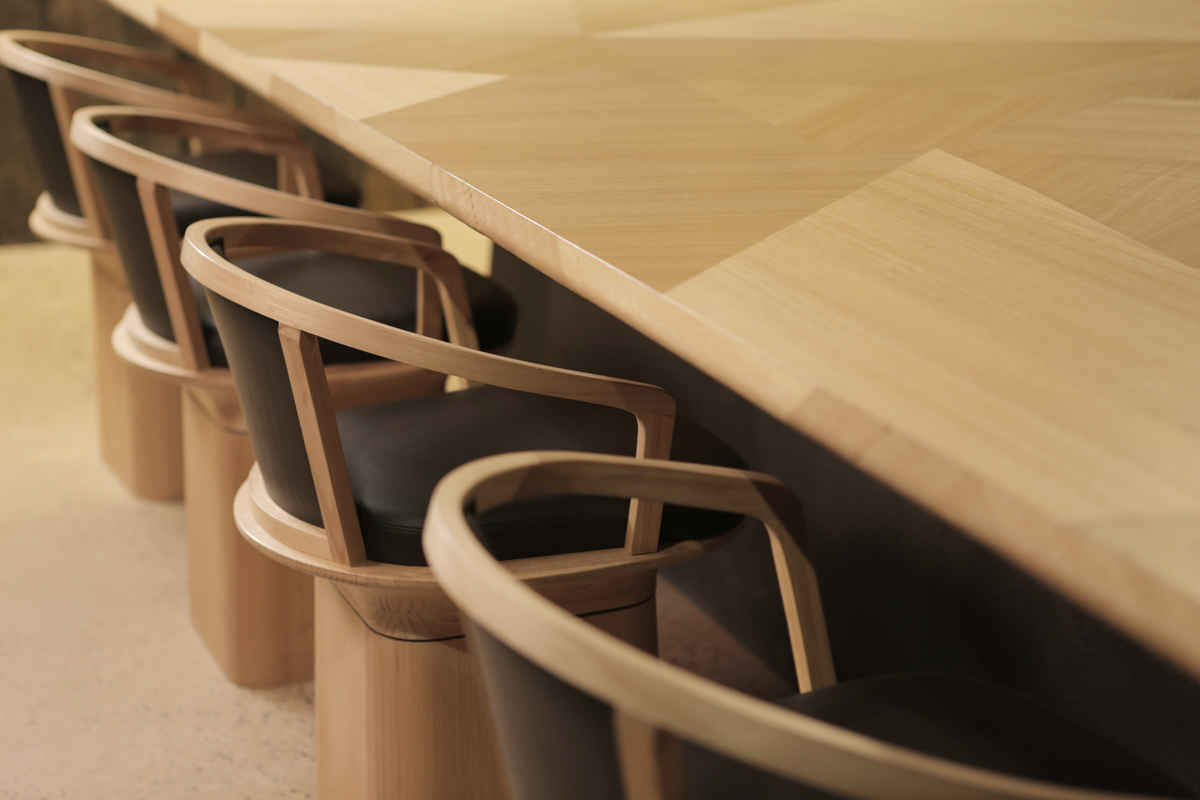
Adam Goodrum designed the boardroom table to describe how the Molonglo Group, run and owned by the Efkarpidis family, was built. The first generation established the company’s capacity to administer and deliver projects; the second generation used that foundation to negotiate the many contracts needed to deliver a precinct as complex as NewActon and Dairy Road. The table’s bluestone base represented the first generation and its patchwork top the second.
Stone was chosen because it had been the material of democratic civic architecture since Ancient Greece, and because it signified the company’s permanence in Canberra. The white timber top referred to the conventional boardroom, a plain room where proposals were pitched, cashflows projected and deals signed. The chairs were upholstered in the same leather as the workstation tables. The boardroom sat within a freestanding cabin built inside the headquarters.
Diaspora Light
A diaspora is a community of people living outside the country they or their ancestors came from. The Efkarpidis family migrated from Greece to Australia and supported both the Greek community in Canberra and Greece itself. Trent Jansen designed the Diaspora Light as a companion to the Council of Nicea table. The council gathered bishops in one place so that a single doctrine would travel outward unchanged, and the light addressed what happens to a culture when its people move away.
Migrant communities often keep the customs, language and religious practice they arrived with more strictly than the homeland does, because those practices hold the community together in a new country. The homeland continues to change, and the further away migrants live and the less often they return, the less familiar it becomes to them. The pendant was made in glass by Jeremy Lepisto and hung in the common area of the headquarters.
Council of Nicea Table and Chairs
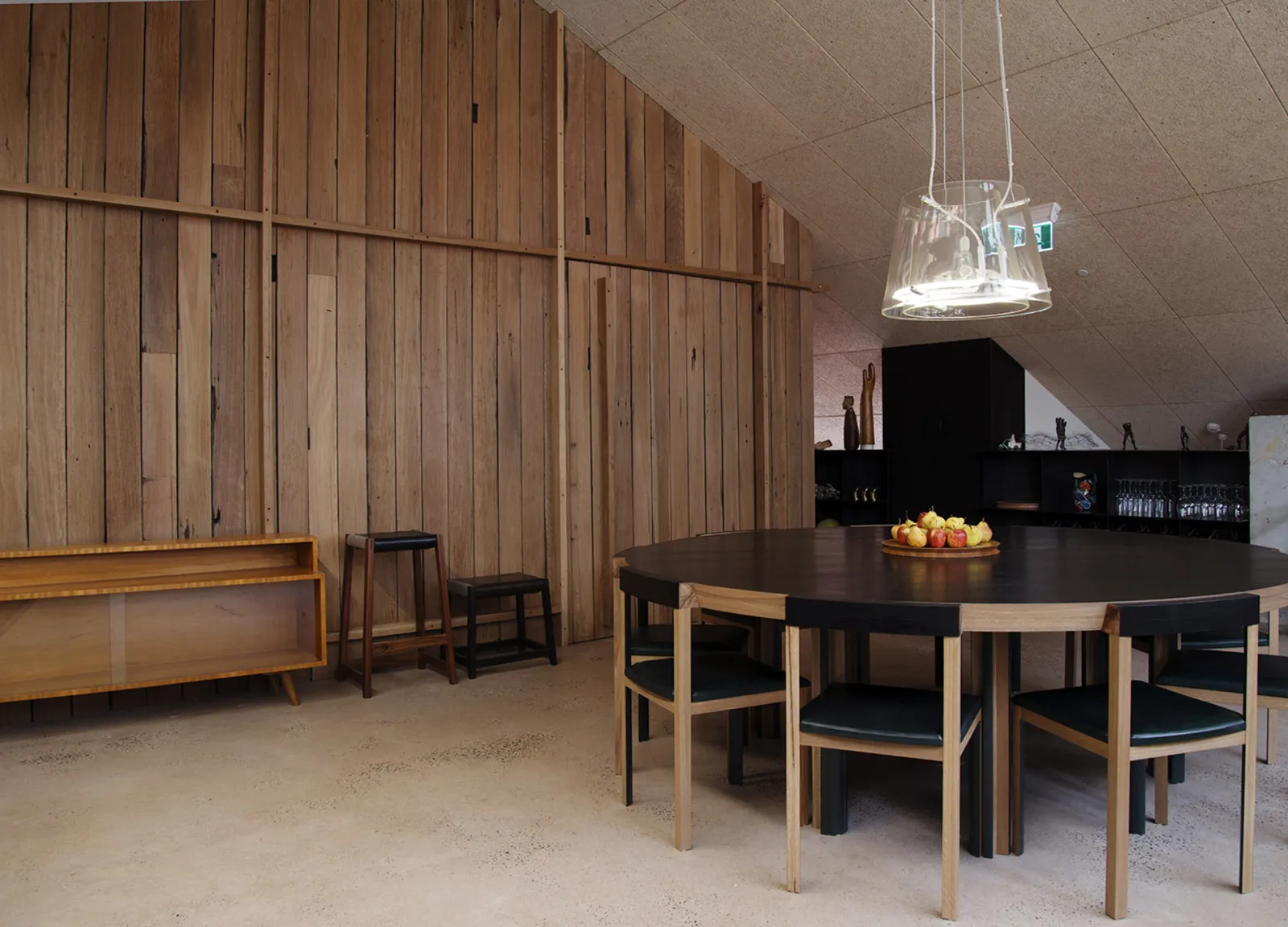
In 325 AD the Roman emperor Constantine convened between 250 and 318 bishops at Nicaea in Anatolia, the region where the Pontian Greek ancestors of the Efkarpidis family had lived for centuries. The council was called to settle a single doctrine for the Christian church. Its central dispute concerned whether Jesus was made of God, and so shared God’s divinity, or made by God, and so was God’s most perfect creation but a creation nonetheless. The bishops ruled that he was of God.
Trent Jansen designed this collaborative table for the second-floor kitchen of the headquarters, where staff met informally to test new ideas and reach agreement. He treated the table as the father and the chairs as his children, in reference to the family’s intergenerational business. Each chair was cut from the body of the table and, when pushed in, nested back into the leg and top it came from.
Workstation Tables
The workstation tables repeated the structure of the boardroom table: a plain two-toned plinth supporting a patchwork top. Each table was six metres long. Molonglo Group asked for leather work surfaces, and Adam Goodrum arranged the hides so that the natural line of each skin ran across the table, producing a patchwork that matched the boardroom top.
The leather was laid by working cobblers, because Ioannis Efkarpidis, grandfather of the company’s directors Nectar and Jonathan Efkarpidis, had made his living as a cobbler. The same leather upholstered the boardroom chairs, so the room where projects were approved and the floor where staff delivered them shared one material.
Cobbler Light
A cobbler’s lamp was a candle surrounded by glass vessels filled with water. Each vessel acted as a lens, refracting the light of a single flame across a shoemaker’s workbench so that work could continue after dark. Broached found these lamps while researching the trade of Ioannis Efkarpidis, grandfather of Molonglo Group directors Nectar and Jonathan Efkarpidis.
The brief asked Adam Goodrum for a pendant that gave gentle reading light over the workstations. His first designs followed the historical lamp closely, and successive iterations adapted the water-filled vessels to electric lighting and contemporary glassmaking. The pendant was developed and made with Jeremy Lepisto, an American glass artist based in Canberra.