Melbourne Quarter
Melbourne Quarter stands where Batman’s Hill once rose above the Kulin grasslands. John Batman built his house on its crown in 1835, and Robert Hoddle used it as the survey point for the city grid, the pattern of lots that placed the land in the market. In 1868 the hill was carved away for railway yards, and for more than a century the site had no public purpose.
Lendlease’s mixed use precinct makes it a destination for the first time since colonisation. Broached’s Creative Director’s Statement set two themes: the grid, as the founding instrument of colonial Melbourne; and the wind, through Bunjil and The Tempest, because this exposed south-western edge of the city needed comfortable places to be outdoors.
In the lobby of One Melbourne Quarter, John Warwicker’s Your Lordship has been Fortunate sets Captain John Lancey’s 1835 description of the hill in the typefaces of the founding era, with Bruce Pascoe’s reading of it as a garden cultivated by the Kulin. Yhonnie Scarce’s Fire, three vitrines set into the paving, holds glass murnong, the yam daisy, in the stages of its preparation. Stanislava Pinchuk and Reko Rennie’s Landscape Amnesia sets Rennie’s shield pattern, the grid, against Pinchuk’s loose threads, the wind, across an office façade. In TiTree Park, Colourama, designed with Oculus, shelters residents from Docklands gusts behind sliding panels of coloured glass, beside Trent Jansen’s cricket stumps and Emily Floyd’s Grass Parrot Family.
Your Lordship has been Fortunate
The artwork on the upper walls of this foyer presents a typographical interpretation of the letter written by Captain John Lancey to his employer, the co-founder of Melbourne, John Fawkner in 1835, the year of colonial Melbourne’s founding.
Lancey’s observations were made where this building stands today. John Batman ended up buying the lot and it became known as Batman’s Hill.
Bruce Pascoe, a novelist and scholar of Indigenous agriculture and language of Bunurong, Yuin and Tasmanian heritage, has provided an interpretation of the letter so it could be understood from a contemporary perspective as describing the hill’s true form, an Indigenous garden tended to by hundreds of generations of the Kulin Nation.
All fonts selected by the artist John Warwicker are ones invented and used around the time of Melbourne’s founding, such as the Caslon typeface, which was used by the British Government in official documents. This approach links the letter to the formal aesthetics of the British Empire.
Colourama
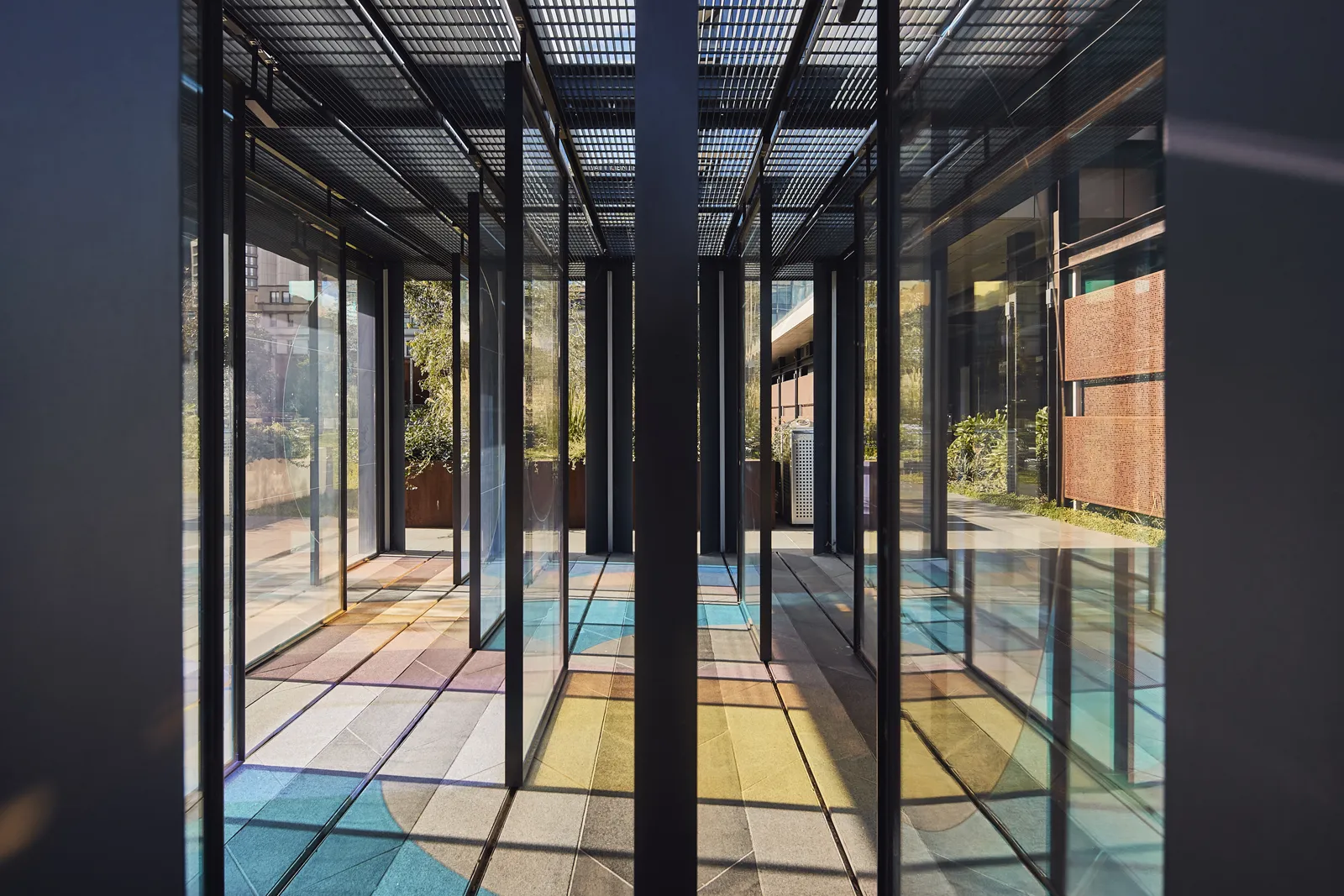
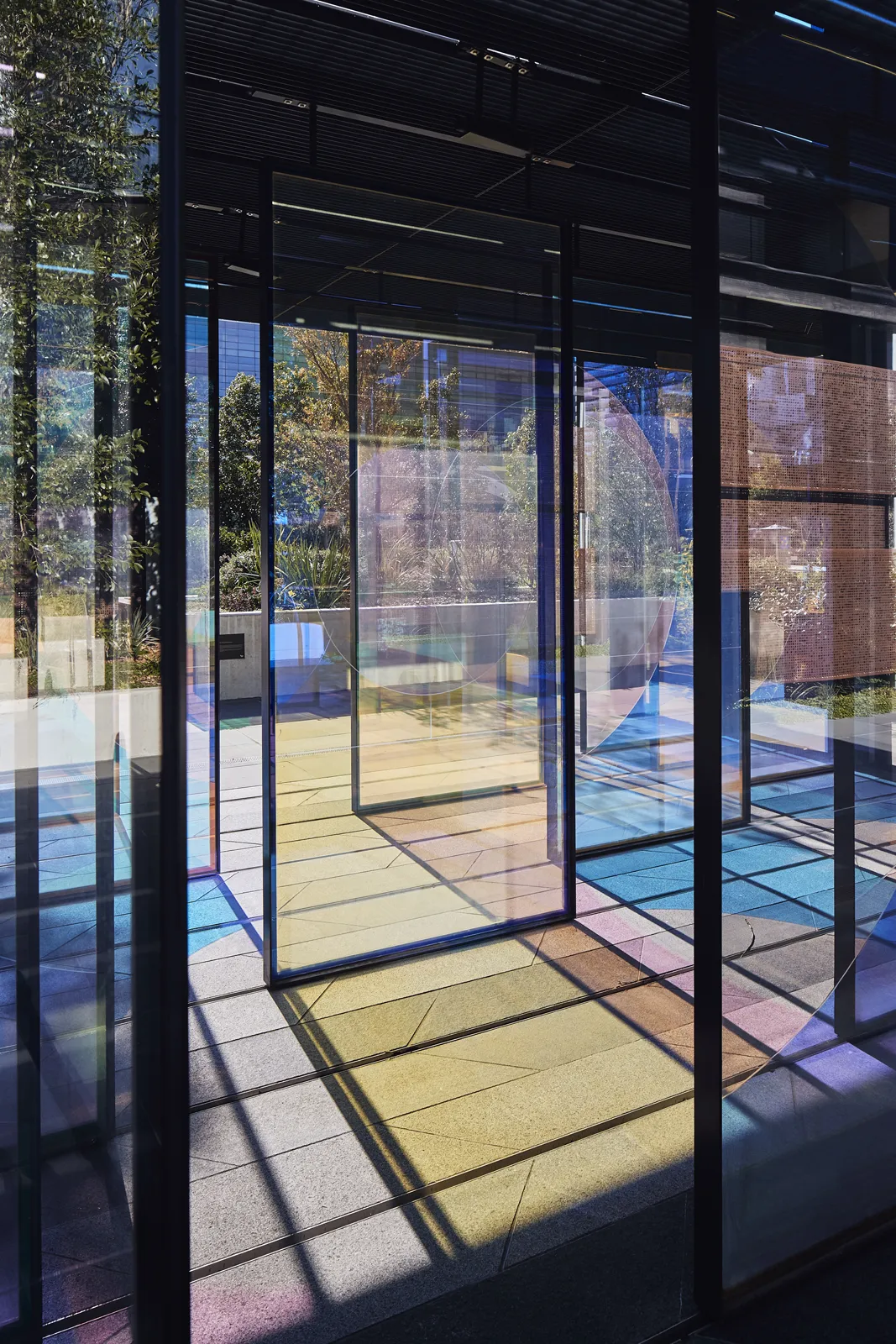
Designed by Oculus and Broached Commissions, the design of the pavilion combines a high modernist line with a playful heart. The overhanging eaves and square core reference a traditional Japanese tea house. This traditional design has been given a Western modernist treatment by being made entirely rectilinear. The sliding dichroic glass screens represent a blending of traditional Japanese shoji screens with a Bauhaus inspired sense of colour play.
The pavilion invites people to gently engage with the sliding panels to create a vast array of colour, shadow and pattern contrasts. Depending on the locations of the panels, the pavilion can be experienced as a playground, maze or sanctuary.
Landscape Amnesia
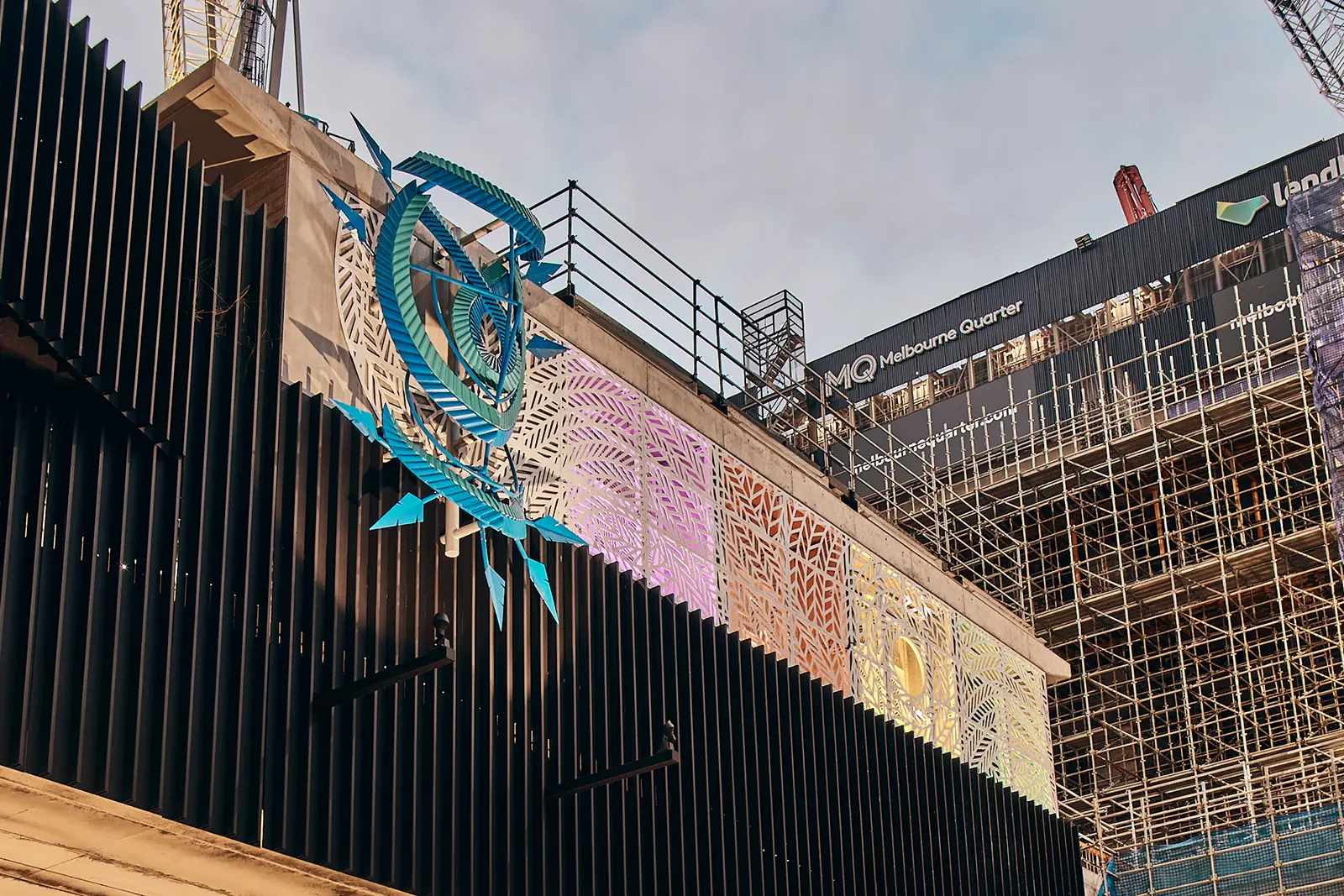
Reko Rennie and Stanislava Pinchuk both started their artistic practices creating street art. Landscape Amnesia continues both artists’ commitment to using simple symbols to make bold political points. In this work Pinchuk and Rennie have used net like lines and Reko’s distinctive vivid shield patterns to create a distorted landscape over the rectilinear grid of commercial office windows.
Reko Rennie has cemented an enormous following within the artworld for his ability to fuse street art aesthetics with iconography from his Kamilaroi heritage. The resulting visual language in Rennie’s work creates a startling collision of styles that challenges stereotyping of indigenous art as always outside the urban realm and its associated styles.
Stanislava Pinchuk’s practice traces the political memory of a place by collecting data and transforming it into forms that appear more closely related to decorative objects than data graphics. Doing so connects the political to the domestic realm. Previous projects include the collecting of tiny pieces of hard rubbish from the vacated refugee camp in Calais, France, and the use of these objects as aggregate in a terrazzo.
An animated projected version of this work is viewable on the interior side of the heritage wall, running along Flinders St.
Fire
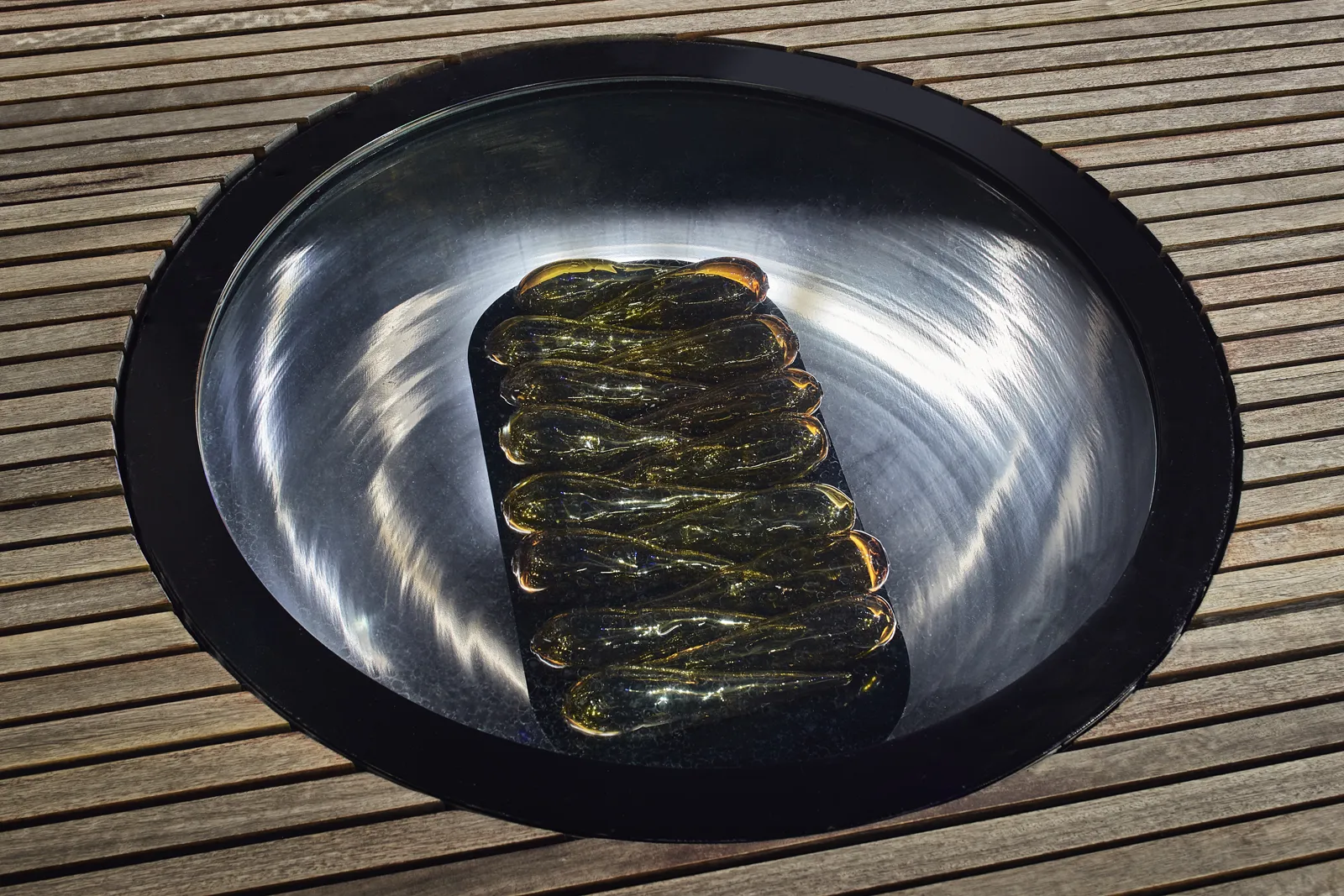
Yhonnie Scarce has created a memorial to the murnong plant, a root vegetable that used to be harvested in this area by the Kulin Nation. The murnong are represented by the hand-blown glass objects in a number of states; buried, as if in a firepit or in their natural subterranean state and also laid out as if ready to eat. The combined works act as memorials and as a gentle suggestion for a return to this sustainable indigenous agriculture.
This work sits on what used to be, according to indigenous author and scholar Bruce Pascoe, an indigenous garden. Early colonial records clearly stated that this site contained an extraordinary array of edible herbs, bulbs and various kinds of mint. By reinstating the murnong, albeit in a sculptural form, Scarce has created a work that is at once archaeological, ceremonial and interpretative.
Grass Parrot Family
This family of sculptural birds continues Floyd’s long-standing commitment to the history of childhood learning objects and sculptures that depict local fauna. The artwork has been designed to specifically engage Melbourne Quarter’s younger inhabitants. Playing with scale and perspective, Grass Parrot Family invites audiences to reimagine the city from the perspective of a child, learning from the environment and envisioning Melbourne Quarter’s urban park as an outdoor classroom.
The sculptures are modelled on the Red Rumped Parrot (Psephotus haematonotus), also known as the red-backed parrot or grass parrot, a common bird of south-eastern Australia.
Emily Floyd acknowledges and pays respect to the Traditional Owners and Elders, past present and emerging, of the lands and waters on which Ti-Tree Garden stands; acknowledging Aboriginal connection to material and creative practice on these lands for more than 60,000 years, and their enduring presence and knowledge.
Stumped
The Melbourne Cricket Club played some of its first games at the foot of Batman’s Hill, the location at which Melbourne Place is now located. To commemorate this important moment in Melbourne and Australia’s sporting history Lendlease commissioned a commemorative set of cricket stumps. Trent Jansen has imagined the stumps as being forced in a makeshift mould using local timber.
Gunpowder Empires
Batman’s Hill is a founding site of modern, colonial Melbourne. Like in many colonial cities, important store houses were placed at the edge of Melbourne’s commercial business district. Buildings that were pivotal in the maintenance and expansion of the colony. In this location once stood a gunpowder magazine – a storage facility for gunpowder.
These five circular Gobo light projections trace the deadly history and evolution of gunpowder from China, into the Ottoman Empire and across Europe. Gunpowder based munitions transformed war and with that civilisation as a whole. The first circle illustrates gunpowder use during the Song Dynasty, China (960–1279) and the last with patent drawings for pistols and rifles by American companies during the civil war period (1861–1865). Over this enormous span of time one sees a dedication to creating weaponry that convey the glory of a feudal Empire and the total inverse of this with the rise of the American empire, which coincides with industrial scale munition manufacture.
Embodied
Grace Lillian Lee’s sculpture is an ode to Binbeal, the Kulin Nation god of the rainbow, son of Bunjil. Embodied represents the first ever public art commission of Grace Lillian Lee. This work represents a radical enlargement of the body-armour and cloth weaving that sits at the heart of Lillian Lee’s fashion practice.
The back wall of the Oculus designed pavilion is occupied by a screen that represents the accumulation of rain, which Binbeal gathers into a rainbow on the outside of the sculpture and weaves into the body armour sculpture. The weave pattern laser-cut into the metal and represented in the folded metal sculpture overlooking Wurundjeri Way is based on Torres Strait Island weaving techniques.
Batman’s Hill Marker
This installation marks the key historical site of Batman’s Hill. Surveyor Robert Hoddle stood atop the hill, using it as a vantage point to chart the city’s now-iconic central grid – a moment that helped shape the city.
In response to this rich historical context, Broached Commissions reimagined the surveyor’s tool, the theodolite, as the main sculptural object and invited artist Maree Clarke to place a kaleidoscopic artwork as the lens through which to view the land.
Located in Melbourne Quarter Square, the precinct and beyond are abstracted by the glass artwork that references the cellular structure of river reeds. The reeds are a central part of Maree’s practice, and continue the historical practice of Louisa Briggs, who used the reeds to create Welcome to Country necklaces.
The theodolite’s design draws from a 19th-century antique, while its plinth speaks to the vertical rise of architecture within Hoddle’s grid, a nod to the city’s evolution from mapped lines to towering forms.
The Grid Begins
Hoddle’s Grid was designed in 1837, two years after John Batman took residence on the hill that used to reside in this very location. It is roughly here that Hoddle stood to survey central Melbourne. This artwork is a brass relief of the original sales map, sourced from the State Library of Victoria.
On 1 June 1837, Hoddle sold 100 half-acre allotments, 2 allotments bought for himself, paying a total of £54; a sum more than covered by his commission of £57 (source, Nadia Rhooks). When this sale happened central Melbourne was still filled with she oak, gullies and swamps. Yet, such was the enthusiasm for the lands within the new colony that the settlement grew rapidly from 177 people in May 1836 to some 3,000 in September 1839.
This work was conceived as a counterpoint to the glass yam daisy vitrines by artist Yhonnie Scarce also placed within Melbourne Square. Hoddle’s grid displaced the agricultural lands of the Kulin Nations, a reality that Scarce’s work contemplates.
Lendlease has committed several works throughout Melbourne Quarter to telling the important and complex role this site has played in the transformation of Melbourne during the early colonial era. This sculpture reveals the success and nepotism that worked hand in hand to carve up what has, for almost two centuries, been informally known as Hoddle’s Grid.
Feature Wall
Batman’s Hill was momentarily earmarked as the location for the Royal Melbourne Botanical Gardens. At the time artist Geoff Nees was working with the holders of all the timber that fell or needed to be removed from the gardens. Each piece was a postcolonial narrative.
We decided to create a work that spoke to how botanical gardens were themselves botanical specimen projects accelerated by colonialism, as they popped up in colonised countries around the world. Geoff created a work that utilised this rare timber and worked into a pattern language that fit his artistic practice’s focus on geometric abstraction.